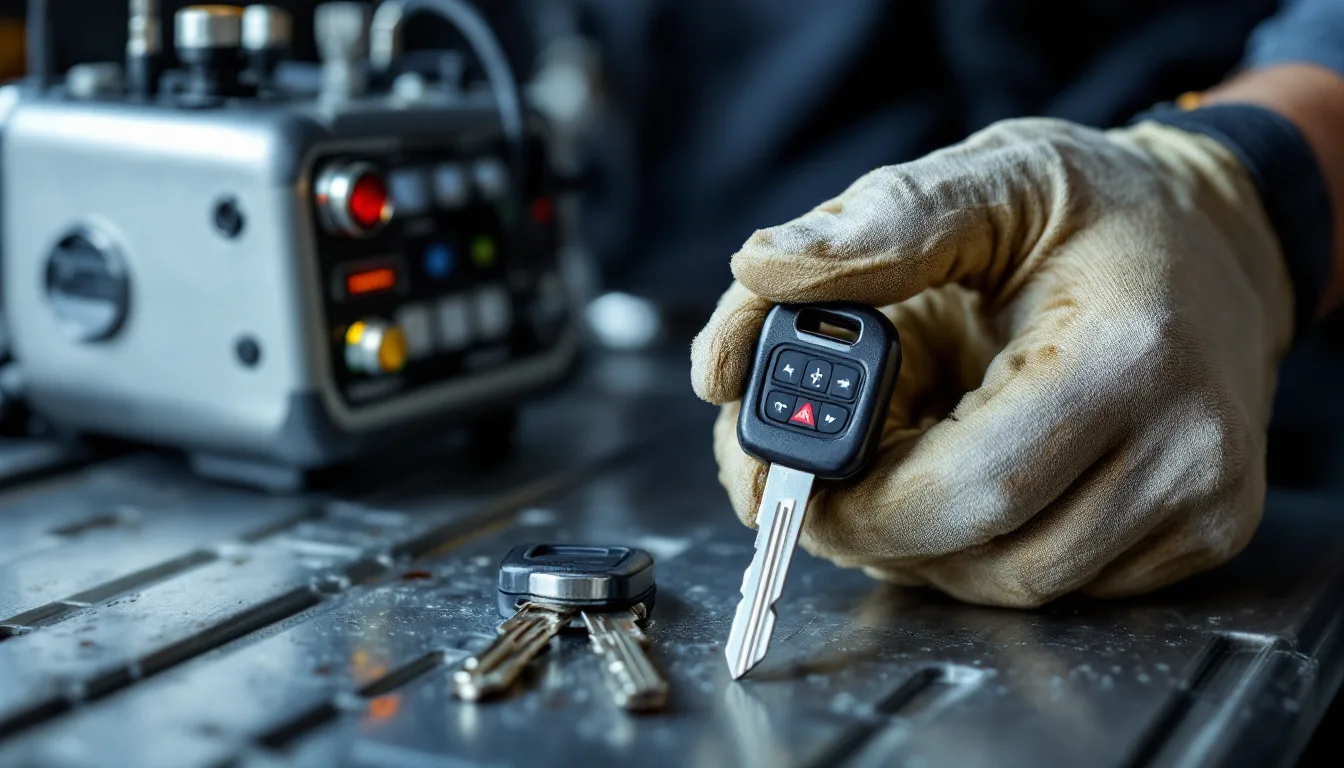
Toyota Camry and Corolla Ignition Repair in Fort Worth — Bladed Years, Push-Button Trims and 2026 Costs

Quick answer: Ignition repair on a Toyota Camry or Corolla costs $150–$550 in Fort Worth. On the bladed-ignition years — roughly 2002 through 2017 — the usual culprits are a worn key, worn cylinder wafers, or a steering lock binding, and all three are fixed at the vehicle. On 2018-and-newer push-to-start trims there is no cylinder to wear at all, so a no-start is a key, fob, or security issue rather than a mechanical one. We are mobile-only and answer 24/7 at (817) 674-3595.
As of August 2026, Camrys and Corollas are the two most numerous cars we see in Fort Worth by a comfortable margin, and they generate two entirely different kinds of ignition call depending on which side of a design change your car sits on. That distinction is the whole point of this guide, because the wrong mental model sends owners chasing the wrong repair. A Corolla whose key will not turn and a Corolla that says the smart key is not detected are not variations of one problem — they are separate problems that happen to end with the same outcome, which is a car sitting still.
Two eras wearing the same badge
The bladed era, roughly 2002 through 2017. You insert a metal key into a cylinder on the steering column and physically turn it. That cylinder is a stack of small spring-loaded wafers, and wafers wear. These are the cars that generate true ignition-repair work.
The push-to-start era, 2018 and newer on the trims that have it. There is no cylinder. A proximity fob authenticates to the vehicle, you press a brake pedal and a button, and a computer decides whether to crank. Nothing mechanical is being ground down by daily use, because nothing mechanical is involved.
Toyota did not flip a switch on a single date. Push-button start appeared on higher Camry and Corolla trims before it became common, and plenty of 2018-and-later cars still shipped with a bladed key. The reliable test is not the model year, it is the dash: a slot you turn means bladed, a round START/STOP button means proximity.
Everything below is organized around that split.
The bladed years — what actually wears out
Toyota ignition cylinders are not fragile. They are just finite. Somewhere north of 150,000 miles, on a car that has been started three or four times a day for fifteen years, three things have been happening quietly.
The brass wafers are wearing thinner. Every insertion drags a steel key across them. Tolerances open up, and the cylinder gets sloppy before it gets stubborn.
The return springs are getting tired. Wafers stop snapping back to position, so the cylinder binds one morning and behaves perfectly by lunch. This intermittent stage typically runs for months before it becomes a hard failure, and it is the ideal moment to fix the car cheaply.
The key is wearing too. This is the half people ignore. Key blades are soft enough that a decade of pocket time and daily turning rounds off the peaks and valleys that do the actual work. A worn key in a worn cylinder is two partial failures compounding.
The accelerant, on Camrys and Corollas specifically, is the keyring. These cars get shared — a commuter key, a teenager's key, a second-driver key — and shared keys collect weight. A ring loaded with a fob, a gym tag, and a handful of other keys is a pendulum hanging off the cylinder every mile you drive. Slimming that ring down is free and it genuinely extends cylinder life.
Push-to-start trims — nothing to wear, different failures
If your Camry or Corolla has a START button, an "ignition problem" almost never means a mechanical fault. What it means instead, in rough order of frequency:
- A dead coin cell in the proximity fob. Range has been shrinking for weeks, and now the car reports no key detected. Toyota builds a backup method into these vehicles that lets the car read a nearly flat fob at very close range; your owner's manual documents the exact spot.
- A failed fob. Fresh battery, still nothing, or one button stopped working, or the fob met water. Hardware failure, and it needs replacing and pairing — push-to-start smart key work.
- A brake-switch or start-system fault. The vehicle will not accept the start request even though it recognizes the key.
- A security or immobilizer refusal. Recognized as a key, refused as a credential.
None of these is repaired by touching a steering column. If you have a START button and someone quotes you an ignition cylinder, get a second opinion.
Reading your symptom on a bladed Camry or Corolla
The key goes in but will not turn, and the steering wheel is locked hard. Try this before anything else: grip the wheel and turn it firmly left and right while applying light, steady pressure to the key. If the front wheels were parked against a curb, the column lock is loaded against the cylinder and simply cannot release. This costs nothing and it resolves a real share of calls.
The key turns, but only with jiggling, lifting, or a specific angle. Classic wear. Your car is telling you it has maybe a few months of warning left. Fix it now, at the cheap end of the band.
The key will not come out. Confirm the shifter is fully in Park and rock it slightly, and confirm the ignition is fully OFF rather than one detent forward. If neither frees it, the cylinder retention has worn. Do not pull hard and do not reach for pliers — that is how a stuck key becomes a snapped key.
The key snapped off in the cylinder. Leave the fragment exactly where it is. Extraction is a routine curbside procedure with the right tools; a fragment that has been poked deeper is a much harder job. This is also covered in our broken key and extraction work.
You are locked out and the key is visible on the seat. Different problem entirely, and a cheaper one — see what to do when you are locked out of your car before assuming anything about the ignition.
Worn key or worn cylinder — settle it in thirty seconds
Grab your second key.
If the second key turns smoothly, the cylinder is healthy and your first key is worn out. The fix is a new key, and the critical detail is how it is made: a duplicate traced from your worn key copies the wear and fails again. A key cut to the vehicle's factory code comes out at original dimensions.
If both keys behave identically badly, the shared component is the problem. That is the cylinder, and the repair is a cylinder service or replacement with keys matched to it.
If you have no second key, that is worth fixing regardless of how today's repair goes.
Ignition fault or immobilizer fault
The cleanest test in automotive locksmithing applies here.
The key will not physically turn. Mechanical. Cylinder, key, or steering lock. $150–$550.
The key turns normally and the starter spins the engine strongly, but it never fires. The cylinder did its job perfectly. This is Toyota's immobilizer declining the transponder in your key, and it is a key or security matter — car key replacement at $150–$850, or a security diagnosis if a known-good key is also refused. Watch the security indicator on the dash: a light that flashes persistently during a crank-no-start is the immobilizer speaking.
Getting this right before you authorize work is exactly what the FTC's auto-repair guidance (consumer.ftc.gov) is about — diagnosis first, parts second. The immobilizer itself is not the enemy, either. The Insurance Institute for Highway Safety (iihs.org) has documented for years how much these systems cut vehicle theft, and NHTSA (nhtsa.gov) maintains the federal theft-prevention framework behind them. We will never disable or bypass one, and proof of ownership is required on every job.
Camry and Corolla by year band
| Year band | Ignition type | Most common failure | Typical fix and price range |
|---|---|---|---|
| 2002–2008 Camry and Corolla | Bladed cylinder, chipped key | Worn wafers plus a worn key, hard-to-turn ignition | Key cut to code, cylinder service as needed, $150–$450 |
| 2009–2013 | Bladed cylinder, chipped key | Intermittent binding, key stuck in the cylinder | Cylinder repair or replacement, keys matched, $200–$520 |
| 2014–2017 | Bladed cylinder on most trims | Steering-lock binding, worn key, snapped blade | Column lock release, extraction, new key, $150–$480 |
| 2014–2017 upper trims with a START button | Proximity, no cylinder | Dead fob battery or failed fob | Battery or fob paired on site, keys $150–$850 |
| 2018–2026 with a START button | Proximity, no cylinder | Fob battery, failed fob, security refusal | No cylinder work applies; fob or security path |
| 2018–2026 with a bladed key | Bladed cylinder, low mileage on the wear clock | Rarely worn out yet, usually a damaged key | New key cut to code, $150–$320 |
Ignition work stays within $150–$550 across every bladed row. A tech confirms your exact configuration and quotes before any work starts.
What the visit looks like
We are mobile-only, which matters here more than it sounds. A Camry with a snapped key in the cylinder is not driving to a service bay, and a tow to save nothing is a waste. The truck comes to the car, whether that is a driveway, an apartment lot near the TCU area, or a shopping center on Camp Bowie.
The order is consistent: verify ownership with photo ID plus registration, title, or insurance matching the VIN; reproduce the symptom rather than working from a description; rule out the free causes first, meaning the steering lock and the Park interlock; then diagnose the key against the cylinder. Only after that does anyone talk about parts. Ignition repair on these cars is usually a thirty-to-ninety-minute job on site.
Texas locksmiths operate under the Texas DPS Private Security Program (dps.texas.gov), and legitimate access to manufacturer key data runs through the National Automotive Service Task Force's Vehicle Security Professional framework (nastf.org). Anyone who does not ask who owns the car is someone to send away.
High-mileage ignition wear is not a Toyota trait, incidentally — it is a mileage trait. The same story plays out on Korean compacts in our Veloster and Accent ignition guide and on domestic sedans in the Fusion and Taurus ignition guide.
Call (817) 674-3595 or email contact@locksmithfortworth.net, any hour of any day.
Frequently Asked Questions
How much does ignition repair cost on a Toyota Camry or Corolla?
$150–$550 in Fort Worth. Releasing a bound steering lock or cutting a fresh key to the factory code sits at the low end, extracting a broken key sits in the middle, and replacing a worn cylinder with keys matched to it sits at the high end. A tech quotes after confirming your exact setup.
Why will my Corolla key not turn in the ignition?
The two most common reasons are a steering-column lock binding because the front wheels are turned against a curb, and ordinary wear in the cylinder or the key. Try turning the wheel firmly side to side with light pressure on the key first. If that fails, test your second key to separate a worn key from a worn cylinder.
Do 2018 and newer Camrys have an ignition cylinder that can wear out?
Only if your car has a bladed key. Trims with a round START/STOP button have no ignition cylinder at all, so there is nothing mechanical to wear. On those cars a no-start is a fob battery, a failed fob, or a security issue, and no ignition repair is involved.
Is my problem the ignition or the immobilizer?
Watch what the car does. If the key will not physically turn, it is mechanical. If the key turns and the starter spins the engine strongly but it never fires, the cylinder is fine and the immobilizer is refusing the key - that is a key or security job, not an ignition repair.
Can a locksmith fix a Toyota ignition without towing the car?
Yes. Cylinder service and replacement, broken-key extraction, and cutting a key to the vehicle's factory code are all done at the vehicle by a mobile tech. Since a car with a failed ignition usually cannot be driven, doing the work where it sits avoids a tow entirely.
My key is stuck in my Camry ignition - what should I do?
Put the shifter fully into Park and rock it slightly, then make sure the ignition is turned fully to OFF rather than one position forward, and try again gently. Do not pull hard or use pliers. If the key has already broken off, leave the piece alone so it can be extracted cleanly.