Rekey vs Replace Locks Fort Worth (2026): Cost Comparison for Sundance Square + West 7th Apartments
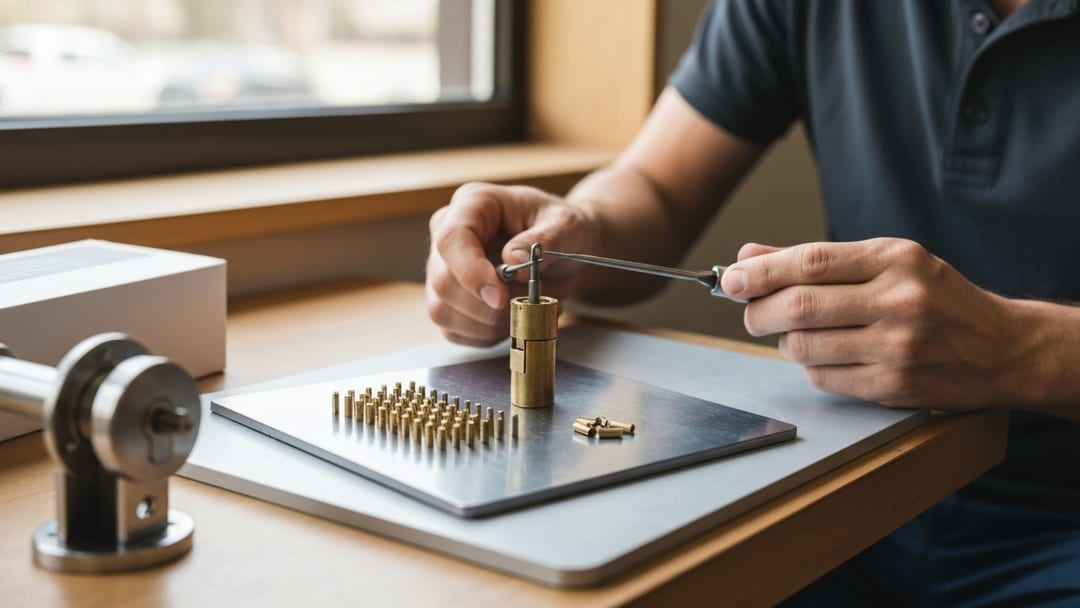
Quick answer: Rekeying four standard residential locks in Fort Worth runs $85-$180 in 2026, while full replacement of the same four cylinders runs $260-$640 depending on the grade of hardware specified. Rekey is the right answer in roughly 70 percent of cases — after a move-in, after a contractor finishes, after losing a key, or after a relationship ends — because the existing cylinders are mechanically fine and only the pin combination needs to change. Replacement is required only when the cylinder is damaged, corroded, mismatched on a multi-door house, or when you are deliberately upgrading from a Grade 3 builder lock to a Grade 1 or high-security cylinder. Texas Property Code Chapter 92.156 requires landlords to rekey residential rental units between tenants in most cases, but does not specify whether rekey or replacement satisfies the requirement — either works.
What is the difference between rekeying and replacing a lock?
Rekeying changes the internal pin arrangement of a lock cylinder so the old key no longer works. The cylinder body, the deadbolt mechanism, the strike plate, and the exterior trim all stay on the door. The locksmith pulls the cylinder, dumps the existing top and bottom pins, picks a new key bitting from a code book, and re-pins the cylinder to that new bitting. The whole operation takes 15-25 minutes per cylinder for a competent technician. The end product is a lock that looks identical from outside but accepts only the new key.
Replacement removes the entire cylinder, the deadbolt, and usually the latch — sometimes the strike plate as well — and installs new hardware in the same prep holes. The exterior trim changes, the keyway can change (you might go from Kwikset KW1 to Schlage SC1), the finish can change (oil-rubbed bronze to satin nickel), and the cylinder grade can change (Grade 3 builder hardware to a Grade 1 commercial deadbolt). Replacement takes 25-40 minutes per opening including the time spent verifying that the new latch lines up with the existing strike plate.
The cost gap is structural, not arbitrary. Rekeying reuses every part of the existing hardware except for a handful of $0.40 pins. Replacement requires the locksmith to bring new cylinders, pay for the hardware, and dispose of the removed pieces. Even a budget Grade 3 Kwikset replacement runs $35-$65 in hardware cost before labor, while the pin kit for a rekey costs the locksmith about $2 worth of parts. That is the math that produces a 3x-4x price difference on the same door.
Rekey vs replace pricing — Fort Worth 2026 (4-cylinder residential)
| Scenario | Rekey cost | Replace cost (parts + labor) | Time on site |
|---|---|---|---|
| Single deadbolt (front door only) | $25-$45 | $95-$210 | 15-25 min |
| Front + back deadbolts (2 cylinders, keyed alike) | $55-$95 | $170-$390 | 30-45 min |
| House standard (front, back, garage entry, slider — 4 cyls) | $85-$180 | $260-$640 | 45-90 min |
| Whole-house with high-security upgrade (Medeco) | n/a (new cyls) | $650-$1,400 | 90-150 min |
| Apartment turnover (2 cyls — TX 92.156) | $45-$85 | $160-$340 | 25-40 min |
| Light commercial — 6 cyls keyed-alike on Schlage C | $120-$240 | $420-$880 | 60-100 min |
| Mailbox or cabinet rekey (per cylinder add-on) | $15-$30 | $45-$110 | 10 min each |
When does rekeying make sense for a Fort Worth household?
Move-in to an existing home is the textbook case. The previous owner kept their keys, their kids kept their keys, the cleaning service kept their keys, the dog-walker kept their keys, and the realtor's lockbox key sometimes still works. The Texas Property Code Chapter 92 protections for tenants do not apply to homeowners — when you buy a Fort Worth house, you inherit whatever key history the prior owner created, and your only path to fresh key control is rekeying or replacement on day one. Rekeying handles this for $85-$180 across the four standard openings on most Fort Worth homes (front door, back door, garage interior entry, sliding patio door).
After a contractor or remodeling project finishes is the second clean case. If a general contractor or a subcontractor needed access to the house while you were at work — common during a Berry Street kitchen remodel, a Tanglewood bathroom renovation, or a Crestwood roof replacement — they almost certainly had a key. Even if you trust the lead contractor, you usually do not know every subcontractor and laborer who handled the key. Rekeying after final-walk is the standard professional recommendation from both ALOA and the FTC consumer alert library.
After losing a key — particularly after a wallet or purse theft where the address can be derived from your driver license — rekeying within 24 hours is the textbook response. The labor cost is the same whether you rekey one door or four, so most Fort Worth households rekey the whole house at once. Insurance claims for a property crime that follows a key theft sometimes require evidence of remediation, and the locksmith's invoice with the rekey bitting code (not the actual cuts — that information stays internal) is the standard documentation.
After a relationship ends or a roommate moves out, rekeying is faster, cheaper, and less confrontational than asking for keys back. A Sundance Square condo turnover, a West 7th apartment lease assignment, or a Cultural District duplex split-up all run the same play: rekey within 48 hours of the move-out, retain the locksmith invoice as a paper trail.
When does full replacement make more sense?
Replacement is the right call in five situations. First, the cylinder is mechanically compromised: a key broke inside the keyway and the extraction damaged the pins; the cylinder shows corrosion (common on patio sliders in older Park Hill and Berkeley Place homes); the deadbolt no longer throws smoothly into the strike; or there is visible wear from years of brute-force entry attempts. Rekeying a compromised cylinder is throwing good money after bad — the failure point is the mechanical condition, not the pinning.
Second, the hardware is below grade for the door it protects. A 1995-era builder-grade Kwikset 400 on the front door of a $750,000 Tanglewood home is a security mismatch even when freshly rekeyed — a tap-pick or bump-key attack defeats it in under 90 seconds regardless of the pin combination. Replacing it with a BHMA Grade 1 Schlage B660 or a Grade 1 Medeco Maxum solves both the security gap and the keying. Same math applies to the original Schlage F-series knob locks on most Westcliff and Tanglewood homes built before 2005.
Third, the household needs new functionality the old hardware cannot provide. Smart-lock conversion (covered in our Yale vs Schlage vs August guide), keypad-only conversion for short-term rentals, or moving from a thumbturn deadbolt to a double-cylinder deadbolt on a door near a sidelight all require new hardware regardless of the rekey question.
Fourth, the multi-door key system needs unification. If a Fort Worth house has accumulated five different keys over twenty years — original front door key, replacement back door key after a 2014 break-in, garage entry key from a 2019 builder repair, slider lock from a 2022 patio addition, mailbox key from the post office — keying them all alike via rekeying is technically possible if all five share a keyway. In practice, mixed keyways are common (Kwikset front, Schlage back, generic patio), and unifying them requires replacement to a single keyway.
Fifth, the homeowner wants restricted-keyway protection. Stock Kwikset and Schlage keys are duplicated freely at any Home Depot or Ace Hardware. If the threat model includes an unauthorized copy made by someone who briefly had access — a teenage child's friend, a short-term contractor, an Airbnb guest — moving to a restricted keyway like Medeco BiLevel or Mul-T-Lock MT5+ requires replacement. Rekeying a stock cylinder does not change the keyway.
- Mechanical damage: snapped key extraction, corroded cylinder, worn deadbolt mechanism
- Hardware grade mismatch: Grade 3 builder lock on a high-value home
- New functionality needed: smart lock, keypad, double-cylinder, anti-bump pins
- Multi-keyway unification: too many different keyways to rekey-alike
- Restricted keyway upgrade: Medeco, Mul-T-Lock, Abloy require new cylinders
Sundance Square + West 7th apartment leases — what does Texas law require?
Texas Property Code Chapter 92, Subchapter D, governs residential rental security devices statewide. Section 92.156 specifically requires the landlord to rekey or change the security devices not later than the seventh day after a new tenant turns over occupancy — meaning when you move into a Sundance Square apartment, a West 7th high-rise, a Near Southside loft, or a Cultural District duplex, your landlord is legally obligated to provide rekeyed locks within a week of you taking possession. The statute does not require the tenant to ask for it; the obligation is automatic.
If the landlord misses the seven-day deadline, the tenant has the right under Section 92.165 to rekey the locks at their own expense and deduct the cost from the next rent payment, after providing written notice. The deduction is capped at a reasonable cost — which a typical Fort Worth rekey at $25-$45 per cylinder easily satisfies — and the landlord cannot retaliate. Sundance Square Downtown Management apartments, West 7th leasing offices, and most Cultural District property managers will handle the rekey automatically as part of the turnover; ask for the locksmith's invoice or a property-management work order confirming the date if you want a paper trail.
The statute does not specify rekey versus replacement — the landlord can satisfy the obligation either way. Most professional Fort Worth apartment managers rekey rather than replace because the math is the same as for a homeowner: rekeying is 30-50 percent cheaper and uses no new hardware. The one exception is high-end Sundance Square condos and Cultural District luxury rentals, where the hardware may already be high-security Medeco or Mul-T-Lock, in which case rekeying via the restricted-key authorization (signed cards on file with the issuing locksmith) is the only path that preserves the security level.
A common confusion in Fort Worth lease turnovers: the lockbox key used by the leasing agent to show the unit is NOT the same as the resident key. After move-in, the lockbox is removed and only the resident key works the door. If a tenant ever finds a lockbox still attached to their door after move-in, that is a sign the rekey did not happen and the Section 92.156 clock should be checked.
Can I rekey my own locks with a DIY rekey kit?
Kwikset SmartKey and Schlage SecureKey both publish DIY rekey tools that homeowners can buy at any Fort Worth Home Depot or Lowe's for $15-$25. The mechanism is elegant — insert the current key, insert a small reset tool, insert the new key, turn — and it works reliably on the supported product lines (Kwikset SmartKey deadbolts and knobs from 2006 onward, Schlage SecureKey deadbolts from 2018 onward).
The catches are real, though. Kwikset SmartKey has a documented bypass vulnerability — a screwdriver-and-wire attack that defeats the cylinder in under two minutes — published by the lock-sport community and reproduced in multiple security research papers. SmartKey-equipped Kwiksets are not the right choice for a high-value Fort Worth home regardless of how convenient the DIY rekey is. Schlage SecureKey does not have the same documented vulnerability but is also not a high-security cylinder; it is a Grade 2 residential lock and should be treated as such.
Outside the SmartKey and SecureKey families, DIY rekeying requires a pinning kit ($25-$80 for the kit), a follower tool, plug spinner experience, and a key-code book or a key decoder. The learning curve is real — first-time DIY rekeyers usually pin one of the pins wrong and have to disassemble twice — and the time cost on a four-cylinder house easily reaches 3-4 hours including the inevitable mistakes. Most Fort Worth homeowners conclude after one attempt that paying $85-$180 for a professional rekey on the four-door house is a better trade than spending Saturday afternoon learning the trade.
For commercial cylinders, multi-keyway systems, master-keyed systems, or any restricted keyway (Medeco, Mul-T-Lock, Abloy, Schlage Primus, Schlage Everest 29-S), DIY is essentially not possible. The blanks are restricted, the pinning math requires charting software at any meaningful door count, and the keyway-specific tools are not sold to retail.
How do I phase a whole-house rekey to minimize disruption?
A four-door Fort Worth house — front, back, garage entry, slider — can be rekeyed in a single 60-90 minute visit with no advance prep beyond meeting the locksmith at the door. Most jobs are quoted flat-rate by the cylinder count, not by the time on site. A typical pricing structure is a service-call base ($35-$55) plus per-cylinder rekey ($15-$30), so the four-door house lands at $95-$175 depending on the keyway and the time of day.
If you want to keep one of the existing keys working — say you bought the house but want to keep the original front door key working for a relative — say so up front. The locksmith can pin the new cylinder to recognize both the old key and the new key, which is called a master-keyed rekey. There is no extra charge for two keys versus one on a basic four-door rekey.
If you want every cylinder keyed alike — a single key opens all four doors of the house — that is the standard request and adds no labor. If you want some doors on one key and other doors on a different key — say the slider on a different key because the housekeeper does not need it — call that out at scheduling and the locksmith will charge a small premium ($10-$25) for the second key code.
After the rekey is complete, you should have at least three copies of the new key: one in your pocket, one in a safe place at home (a fireproof safe, a kitchen drawer, or a hidden lockbox on the property), and one with a trusted neighbor or family member. The locksmith can cut additional copies on the spot at $3-$8 per copy for stock keyways or quote restricted-keyway copies via the authorization card process.
"Rekeying is the single most under-used service in this industry. Most homeowners think they have to buy new hardware after a move, after a contractor finishes, or after a relationship ends. They do not. A competent locksmith can change the pins in twenty minutes per cylinder, and your old key becomes a souvenir."
— Tim McMullen, Past President, Associated Locksmiths of America (ALOA)
Sourced stats
- Texas Property Code Chapter 92, Subchapter D (Security Devices) requires landlords to rekey or change residential security devices between occupancy by different tenants — and the language explicitly allows either rekeying or replacement to satisfy the obligation. — Texas State Law Library (2023)
- ANSI/BHMA A156.36 — the standard governing residential deadbolts — defines Grade 1 (commercial-grade, 250,000 cycle minimum), Grade 2 (heavy residential, 150,000 cycle), and Grade 3 (basic residential, 100,000 cycle) tiers, and most cylinders built to any of those grades are designed for at least one full re-pinning over their service life. — Builders Hardware Manufacturers Association (2024)
- Associated Locksmiths of America publishes the industry's certification path (Registered Locksmith through Certified Master Locksmith) and explicitly identifies rekeying as a core service every certified locksmith is trained to perform without damaging the cylinder. — Associated Locksmiths of America (2024)
- The Federal Trade Commission consumer alert on locksmith fraud cites unnecessary cylinder replacement — when a rekey would have solved the problem — as one of the most common upselling patterns reported to its consumer protection division. — U.S. Federal Trade Commission (2023)
Related services
Frequently asked questions
Will rekeying weaken my locks or change how they feel?
No. Rekeying replaces internal pin tumblers with the same size and grade of pins; the mechanical action of the deadbolt is unchanged. If anything, a fresh re-pinning often makes a sticky old cylinder turn more smoothly because dust and worn-down pin tips are cleared out in the process. Properly rekeyed locks are mechanically identical to factory-new of the same model and grade.
Do I have to be home for the rekey?
Yes, in almost every case. The locksmith needs an adult on site to verify lawful authority (Texas DPS Private Security Bureau standard of care, same as a lockout call), to confirm the keyway and existing key, and to test the new key on each lock before leaving. The total time on site for a four-door Fort Worth house is usually 60-90 minutes; many customers stay for the first 10 minutes to verify and then leave to work from a nearby coffee shop while the locksmith finishes.
How many keys can a locksmith make for a rekeyed lock?
Unlimited for stock keyways (Kwikset KW1, Schlage SC1, Yale Y1) — additional copies are $3-$8 each cut on a key machine in the truck. Restricted keyways (Medeco, Mul-T-Lock, Schlage Primus, Schlage Everest 29-S) limit copies to authorized cards on file, which the locksmith maintains; copies on restricted keyways typically run $8-$25 each and require either the original authorization or a notarized owner request.
Can I rekey my locks if I lost all my keys?
Yes. The locksmith decodes the cylinder from the keyway itself using a key-impressioning tool, a key decoder, or by disassembling the cylinder and reading the existing pin stack. Decoding adds 10-20 minutes per cylinder and a typical charge of $35-$60 on top of the standard rekey rate. The result is a fresh key cut to the new bitting with no reliance on the lost original.
Sources cited
- Associated Locksmiths of America — ALOA Security Professionals Association (2024)
- Builders Hardware Manufacturers Association — BHMA ANSI/BHMA A156.5, A156.36 standards (2024)
- Texas Department of Public Safety — Texas DPS — Private Security Bureau (Locksmith) (2024)
- U.S. Federal Trade Commission — FTC Consumer Alert — Avoiding Locksmith Scams (2023)
- U.S. Small Business Administration — SBA — Office of Advocacy on Small Business (2024)
- Texas State Law Library — Texas Property Code Chapter 92 — Residential Tenancies, Security Devices (2023)
- Consumer Financial Protection Bureau — CFPB tenant protections — security deposit deductions (2024)