Mul-T-Lock vs Medeco High-Security Locks Fort Worth: Which Pin-Tumbler System for Your Stockyards Business?
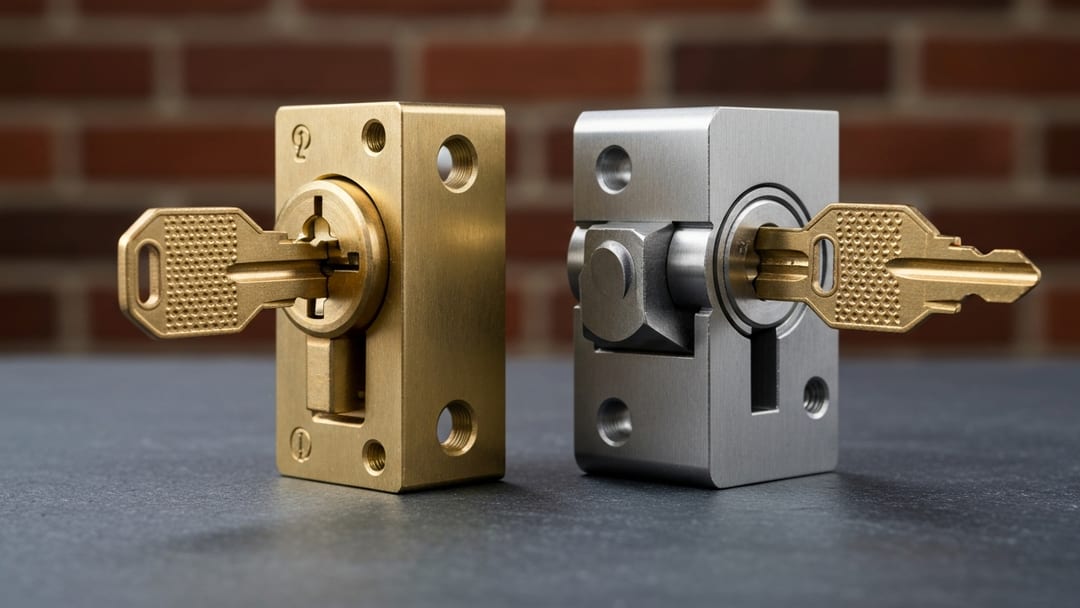
Quick answer: Mul-T-Lock MT5+ and Medeco M3 / Maxum are the two leading high-security pin-tumbler systems for Fort Worth commercial buildings in 2026. Both carry UL 437 listing (the standard for key locks resistant to physical attack), both use patented restricted keyways that block unauthorized duplication, and both run roughly $95-$190 per cylinder in hardware before labor. The differences come down to attack mechanism: Mul-T-Lock uses a telescoping pin system that defeats picking, bumping, and impressioning; Medeco uses angled, rotating bottom pins plus a sidebar that adds a second independent unlock condition. A Stockyards retail tenant with cash on premises, a Sundance Square professional firm with client records, and a Cultural District medical practice handling HIPAA data each have a defensible reason to spec one or the other.
What makes a lock cylinder "high-security" — and what does UL 437 actually test?
A standard residential or basic commercial cylinder defends against one attack: someone trying to use the wrong key. A high-security cylinder defends against four additional attacks: picking (manipulating the pins with a pick set), bumping (a specially-cut key that uses kinetic energy to set the pins), impressioning (reading the cylinder by marking a blank key and filing it down repeatedly), and drilling or other physical force. Underwriters Laboratories UL 437 is the published product standard that defines the test sequence for all four. A cylinder carrying the UL 437 listing has been independently tested to resist 10 minutes of expert picking, 5 minutes of expert drilling, and prescribed levels of sawing, prying, and pulling without opening.
The UL listing is not a marketing claim — it is a third-party certification that costs the manufacturer real money to maintain and is auditable. Both Mul-T-Lock MT5+ and Medeco M3 / Maxum lines carry current UL 437 listings, which puts them in the same defensive category as Abloy Protec2, Schlage Primus XP, ASSA Twin Maximum, and a handful of other top-tier commercial cylinders. Most consumer-grade smart locks, all Kwikset products, and all stock Schlage residential cylinders (B-series, F-series) are NOT UL 437 listed — they pass the BHMA A156.36 residential standard but not the high-security physical attack standard.
ANSI/BHMA A156.30 is the complementary standard that grades the cylinder for cycle count and operational durability. Both Mul-T-Lock and Medeco product lines carry A156.30 Grade 1, which means at least 800,000 cycles in laboratory testing. For a Fort Worth retail tenant where the front door is unlocked and re-locked 8-12 times per day, Grade 1 represents roughly 200+ years of cycle life — meaning the cylinder will be retired for some other reason (lost keys, ownership change, master-key rebuild) long before mechanical wear becomes an issue.
Mul-T-Lock MT5+ vs Medeco M3 / Maxum — Fort Worth commercial pricing (2026)
| Spec | Mul-T-Lock MT5+ | Medeco M3 (standard) | Medeco Maxum (deadbolt) |
|---|---|---|---|
| UL 437 listing | Yes | Yes | Yes |
| BHMA grade | A156.30 Grade 1 | A156.30 Grade 1 | A156.36 Grade 1 |
| Cylinder hardware (each) | $120-$190 | $95-$160 | $160-$230 |
| Restricted keyway expiration | Patent dependent (long) | Patent through 2030+ | Same as M3 |
| Key duplication policy | Signed card, dealer-only | Signed card, dealer-only | Signed card, dealer-only |
| Pick resistance | Telescoping pin system | Rotating angled pins + sidebar | Same as M3 mechanism |
| Bump resistance | High (telescoping defeats) | High (sidebar defeats) | High (sidebar defeats) |
| Drill resistance | Hardened steel inserts | Hardened steel inserts | Hardened steel + free-spinning ring |
| Master key complexity | 8 levels supported | 7 levels supported | 7 levels supported |
| Typical 10-door commercial install (parts + labor) | $2,800-$5,000 | $2,200-$3,800 | $2,800-$4,400 |
Mul-T-Lock MT5+ — how the telescoping pin defeats picking and bumping
The Mul-T-Lock MT5+ platform — Mul-T-Lock's current flagship product line, manufactured by ASSA ABLOY — uses a telescoping pin design that fundamentally changes the picking math. Where a standard pin-tumbler cylinder has 5 or 6 single-piece bottom pins that must each be lifted to the correct height, the MT5+ uses pins that contain internal sleeves. Each pin position effectively requires two independent height settings to align — the outer sleeve and the inner pin — and the lockpicking force needed to set both simultaneously is an order of magnitude higher than for a standard cylinder.
The practical result is that bumping (the kinetic-energy attack using a cut-to-all-9-depth key and a tap from a small mallet) does not transfer enough energy to set the inner pins reliably; the outer sleeve sets but the inner pin moves back into the locked position before the next bump can land. Single-pin-picking (SPP) attacks similarly require setting both the outer and inner element on each pin, which compounds the time and skill required. Mul-T-Lock cites the platform's MT5+ telescoping pin as resistant to even expert-level picking attempts within the UL 437 timed test window.
Bonus features in the MT5+ platform: a hardened steel insert at the front of the cylinder resists drilling for the first 5+ minutes (the UL 437 attack window); a removable interactive element on the key allows for an additional ID layer at facility checkpoints; and the keyway itself uses Mul-T-Lock's proprietary blank profile, which is dealer-restricted and not duplicated by retail key machines. The combination produces a cylinder that defeats every commodity attack mechanism a non-state-level attacker is likely to attempt.
Where Mul-T-Lock MT5+ fits in a Fort Worth commercial portfolio: Stockyards retail tenants with cash on premises overnight; West 7th hospitality and bar operators with high turnover staff (the restricted key control prevents ex-employee unauthorized copies); manufacturing and warehouse operators in the Alliance corridor where uncontrolled key duplication is the primary key-control risk; legal and accounting professional firms in Sundance Square that need a tier-1 commercial perimeter and a master-key system that scales above 20 cylinders.
Medeco M3 and Medeco Maxum — angled pins, sidebar, and the second unlock condition
The Medeco platform takes a different defensive approach. Where Mul-T-Lock makes each pin harder to pick, Medeco adds a second independent unlock condition: the sidebar. In a Medeco M3 or Maxum cylinder, every bottom pin is cut at an angle (not flat like a standard pin) and must rotate to a specific orientation as it is lifted to the correct height. The rotation is driven by a corresponding angle cut into the key blade. Only when every pin is at both the correct height AND the correct rotation does a separate sidebar inside the cylinder retract, allowing the plug to turn.
The picking math gets brutal at that point. A standard 6-pin cylinder has roughly 6 to the 5th-power combinations a picker must work through; a Medeco cylinder with angled pins and a sidebar has 6 to the 5th-power height combinations times 3 to the 6th-power rotation combinations — orders of magnitude more attack surface. Bumping does not work against Medeco because the bump cannot impart the rotational force needed to satisfy the sidebar. Impressioning is extremely difficult because the angles on the cut key are precise and not easily read from cylinder marks. UL 437 test results for both M3 and Maxum reflect this in the pass margins.
Medeco M3 is the standard commercial cylinder — used in rim, mortise, key-in-knob, and key-in-lever applications across a typical office buildout. Medeco Maxum is the high-security deadbolt variant — a free-spinning hardened steel ring around the cylinder face that adds significant drill resistance on top of the M3 angled-pin / sidebar mechanism, and is the cylinder of choice for perimeter doors where forced entry is the primary concern. Both share the same restricted keyway, so a building can be master-keyed across M3 interior cylinders and Maxum exterior deadbolts on a single key system.
Where Medeco fits in a Fort Worth commercial portfolio: Cultural District medical practices (HIPAA physical security expectations under HHS guidance); Sundance Square law firms and accounting firms (client confidentiality, regulated records); Near Southside boutique retail with high-value inventory (jewelry, electronics, firearms-related); financial services storefronts; any facility being designed against the NIST 800-53 PE-3 physical access control requirement; and any tenant who specifically wants the sidebar mechanism in addition to the angled pins for defense-in-depth.
Restricted-keyway duplication — how key control actually works
Both Mul-T-Lock and Medeco run a dealer-restricted key duplication program. When you buy a high-security system from a Fort Worth authorized dealer (any ALOA-credentialed locksmith with the appropriate manufacturer authorization), the dealer maintains a signed authorization card on file. The card lists the building, the system, the authorized signers (typically the owner, the operations manager, and one or two designated alternates), and the bitting codes assigned to the system. To order an additional key copy, an authorized signer either presents identification in person at the dealer, or sends a signed and dated request matching the signature on the card.
The blanks themselves are not sold to retail. A Home Depot key machine cannot cut a Medeco or Mul-T-Lock blank because the blanks are not stocked there — Medeco and Mul-T-Lock both classify their blanks as restricted under their proprietary patents and trademark protections. Even if a sufficiently determined attacker bought a Medeco blank online (the gray-market exists), cutting it correctly without the manufacturer-licensed code-cutting machine and without the rotation-angle data is not practical for a non-specialist.
The downstream practical effect: when a Fort Worth restaurant manager terminates a kitchen staffer, when a Cultural District professional firm parts ways with a paralegal, when a Stockyards retail operator separates from a shift supervisor — the key the departing employee was issued cannot be duplicated and used against the facility. The threat model collapses from 'they could have made a copy at any of fifteen Fort Worth key kiosks in the past six months' to 'they had to physically retain the issued key.' That single threat reduction is the primary business case for high-security keyways at scale.
The dealer authorization model has one operational requirement: the operations manager must keep the authorized signers list up to date. When ownership changes, when the operations role changes hands, or when a long-tenured employee is removed from the authorized list, the dealer needs to be notified in writing — same day. ALOA-credentialed Fort Worth locksmiths maintain this paperwork as a matter of professional practice.
- Signed authorization card on file with the dealer (not the manufacturer)
- Restricted blanks not sold at retail key kiosks
- Dealer verifies signer identity for in-person key copy orders
- Mailed/emailed copy orders must match the signature on file
- Owner-of-record updates require written notice to the dealer
- Authorization card retention typically 7+ years from last system activity
Choosing for your Fort Worth business — three real scenarios
Stockyards retail tenant with cash on premises. A small Western-wear shop, a boot retailer, or a tourist-focused storefront with cash drawer remainders overnight needs three things: drill-resistant perimeter, picking and bumping resistance to defeat the after-hours attack, and key control over staff turnover. Spec: Medeco Maxum on the front and rear perimeter deadbolts (the free-spinning hardened ring is the right answer against drilling), Medeco M3 cylinders on the back office and any interior secured area, all master-keyed on a single signed authorization. Approximate parts-plus-labor: $1,800-$2,900 for a typical 6-cylinder Stockyards retail front-of-house and back-of-house. Insurance underwriters in this risk class often discount premiums 5-12 percent for UL 437 cylinders on perimeter doors.
Sundance Square professional services firm (law, accounting, financial advisory). The threat model here is client confidentiality and regulated records, not cash. The cylinder spec needs to support a master-key system across 12-25 doors (open-plan offices + partners' offices + server room + file storage + supply closet) with strong key control because professional staff turnover and the rotating client / contractor presence creates duplication risk. Spec: Medeco M3 cylinders throughout, master-keyed by department, with the managing partner holding the grand-master and each practice area lead holding the sub-master. Approximate parts-plus-labor: $3,000-$5,000 for a 15-cylinder office. The signed-card duplication policy is the security feature that matters most.
Cultural District medical practice (HIPAA-regulated physical environment). HHS guidance under the HIPAA Security Rule treats physical access control as a foundational safeguard for protected health information storage. A medical practice perimeter cylinder needs to be defensible against the standard set of physical attacks AND auditable in terms of who held a key and when. Spec: Medeco Maxum on perimeter, Medeco M3 on records room, exam rooms, and pharmacy if applicable. Maintain the authorization card with a quarterly review cycle. Approximate parts-plus-labor: $2,200-$4,000 for an 8-cylinder pediatric or family practice. The audit trail produced by the dealer-restricted duplication policy is often the deciding factor in a HIPAA risk assessment review.
Mul-T-Lock MT5+ fits any of the three scenarios above equally well; the choice between Mul-T-Lock and Medeco is rarely about defensive capability (both are UL 437 listed) and usually about which authorized dealer is local, which manufacturer the facility's existing master-key system is built around, and which keyway the facility manager has historical experience with. For a Fort Worth facility starting from scratch in 2026, both are defensible answers.
What does a high-security retrofit actually look like on an existing Fort Worth office?
A retrofit project for a 10-door Fort Worth office typically runs 4-6 hours on site. The locksmith arrives with the manufacturer-shipped cylinders (pre-keyed to the facility's new master key system based on the signed authorization), pulls each existing cylinder, drops in the new high-security cylinder, tests the throw and the latch alignment, and reattaches the existing trim. The deadbolt body, the lockset body, and the strike plate stay in place in roughly 80 percent of retrofits — the cylinder swap fits into existing prep.
The 20 percent of retrofits that require additional work usually involve mortise locks (Medeco and Mul-T-Lock both make mortise-cylinder formats but they may require a different cam length than the existing cylinder), key-in-knob applications where the new keyway profile is slightly different from the old one and the strike alignment needs adjustment, or older buildings (pre-1980 Fort Worth office space in the Sundance Square historic district, certain Stockyards landmark buildings) where the original door prep does not match modern standards.
After installation, the locksmith issues the cut keys to the authorized signers, files the bitting record with the dealer, and provides the operations manager with a system documentation packet: cylinder schedule, key schedule, authorization card, and the dealer contact information for future duplications and re-pinning. That documentation packet is what makes the system auditable for HIPAA, PCI, NIST 800-53, or any other compliance framework that asks 'who has keys and when were they issued.'
"A high-security cylinder is not about keeping a locksmith out — it is about keeping someone with a YouTube tutorial and a $30 pick set out. That is who attacks 99 percent of residences. Spend the extra $80 once and stop thinking about it."
— Clyde Roberson, Director of Technical Services, Medeco Security Locks
Sourced stats
- Underwriters Laboratories UL 437 — the product standard for key locks resistant to physical attack — defines the test sequence (drilling, picking, sawing, prying, pulling) and the minimum cylinder cycle counts that any high-security cylinder must pass to carry the listing; both Mul-T-Lock MT5+ and Medeco M3 / Maxum cylinders are UL 437 listed at the time of writing. — Underwriters Laboratories (2024)
- ANSI/BHMA A156.30 (high-security cylinders) and A156.5 (auxiliary locks) define the rotation cycle and forced-entry resistance grades that commercial cylinders are measured against, separate from the UL physical-attack listing. — Builders Hardware Manufacturers Association (2024)
- FBI Uniform Crime Reporting historically classifies forcible-entry burglaries as the largest sub-category of property crime against commercial premises — making cylinder resistance to picking, bumping, and drilling a meaningful loss-prevention investment, not just a regulatory checkbox. — Federal Bureau of Investigation (2023)
- NIST Special Publication 800-53 (Physical and Environmental Protection control family) treats physical access control and key management as a discrete control domain for federal and contractor facilities — and the high-security cylinder choice on the perimeter is the foundation of the PE-3 control requirement. — National Institute of Standards and Technology (2020)
Related services
- High-security locks installation
- Master key system installation
- Commercial lock installation
- Get a commercial quote
Frequently asked questions
Is Mul-T-Lock or Medeco "more secure" — which one wins?
Neither dominates in the way marketing often suggests. Both are UL 437 listed against the same physical attack standard, both carry BHMA Grade 1, both run dealer-restricted duplication, and both are used by Fortune 500 facilities, federal contractors, and high-end commercial buildings worldwide. The defensive math is different (telescoping pins for Mul-T-Lock, angled pins plus sidebar for Medeco), but the practical outcome — a non-state-level attacker cannot defeat the cylinder in the UL 437 attack window — is the same. The right answer for a specific Fort Worth facility usually depends on which authorized dealer is local, which manufacturer the existing system uses, and which keyway the facility manager prefers operationally.
Can a high-security cylinder be re-keyed when an employee leaves, or do I have to replace it?
Re-keyed. The cylinder mechanism stays in place; only the internal pin stack is changed and a new bitting issued. The same authorized-card process governs the re-pin: an authorized signer requests the re-pin, the dealer assigns a new bitting from the system code book, the locksmith re-pins the affected cylinders on site, and new keys are cut and issued. Total cost for a 10-cylinder re-pin runs roughly $400-$900 depending on the keyway and the number of new keys needed.
How long does the patent on a restricted keyway last, and what happens when it expires?
The Mul-T-Lock MT5+ and the Medeco M3 keyways are protected by current utility and design patents at the time of writing. When a specific keyway patent expires, the manufacturer typically introduces a new keyway profile and migrates new sales to that profile; the older keyway remains supported for existing customers but loses some of the legal protection against gray-market duplication. For a Fort Worth facility planning a 10-15 year system life, the practical answer is to choose the manufacturer's current flagship keyway at install time and migrate at major refresh.
Do high-security cylinders work with cloud access control systems like Brivo or Kisi?
Indirectly. Cloud access control systems read electronic credentials (HID prox cards, mobile credentials, NFC, BLE) and unlock the door via an electric strike or magnetic lock; the mechanical cylinder is only used for the after-hours bypass and for emergency unlock when the electronic system is down. A high-security Medeco Maxum or Mul-T-Lock MT5+ deadbolt is the right answer for that bypass cylinder — it preserves the high-security perimeter standard even during a power outage or network failure that disables the cloud system. Most Fort Worth commercial buildings spec exactly this combination.
Sources cited
- Builders Hardware Manufacturers Association — BHMA ANSI/BHMA A156.5, A156.36 standards (2024)
- Associated Locksmiths of America — ALOA Security Professionals Association (2024)
- Underwriters Laboratories — UL 437 / UL 10C product certifications (2024)
- Medeco Security Locks (ASSA ABLOY) — Medeco — high-security locks product line (2024)
- Mul-T-Lock (ASSA ABLOY) — Mul-T-Lock — MT5+ platform overview (2024)
- National Institute of Standards and Technology — NIST SP 800-53 — Physical and environmental protection controls (PE family) (2020)
- Federal Bureau of Investigation — FBI Uniform Crime Reporting — Property Crime / Burglary (2023)
- U.S. Small Business Administration — SBA — Office of Advocacy on Small Business (2024)